
Every Container Moved Before the Clock Runs Out.
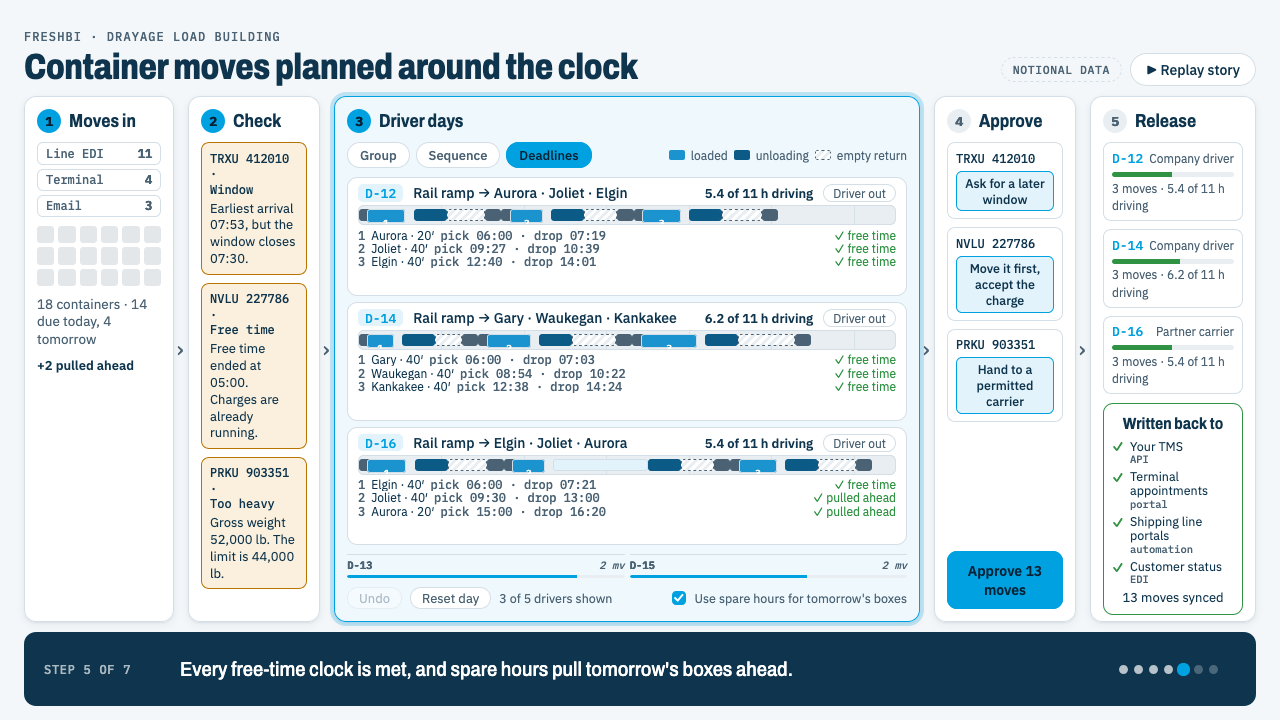
A container is only free for so long. One AI-driven workflow chains the day's container moves into driver days, sequenced by free-time deadline and fitted to gate times, delivery windows and the driver's hours, so charges stop surprising you and spare hours pull tomorrow's boxes ahead.
- 1Every clock watched. Each move is planned against the time its container stops being free, not the order it arrived.
- 2Spare hours put to work. When a driver's day has room, boxes due tomorrow are pulled ahead, and every free-time clock still holds.
- 3Exceptions flagged early. A window that closes too early, free time already over or a box over the weight limit is flagged before dispatch.
01The problem
From dispatching in arrival order to planning by deadline
Moves dispatched as they arrive
- The free-time clock sits in a line or terminal portal, away from dispatch
- A box that arrived first is moved first, whether or not its clock is the shortest
- Appointment windows and driver hours are checked one move at a time
- Charges show up on an invoice weeks later
Moves planned by deadline
- Every move carries its free-time deadline into the plan
- Moves are chained into driver days, earliest deadline first
- Gate times, windows and the 11-hour limit are checked on every day
- The planner sees only the few that need a decision
02The workflow
From the first container to a released driver day
Five steps, one record. The heaviest work happens in the middle, where loose moves become driver days.
- Moves in One clean list
- Check Flags what cannot go as entered
- Driver days Group, sequence and fit
- Approve You decide the exceptions
- Release Drivers, your TMS, terminals and customers
03See it live
Watch a day of container moves, then change the plan
The workflow plays on its own. Then drag a move to another driver, take a driver out, or switch off the spare-hours option and watch the day re-plan.
Notional containers, consignees, times and distances. Free time is modelled as the last moment a box may leave the terminal. Real demurrage, detention and per diem terms differ by port, shipping line and contract, and are not modelled here. The planner uses plain rules (earliest deadline first, then the cheapest feasible day), not a language model, and it does not guarantee the best possible plan. Driver hours shown are driving hours against an 11-hour limit. No move is dispatched and nothing is written to a TMS, terminal or shipping line system.
04Your rules
It plans inside the limits you already run
Rules are settings, not custom code, and a planner can change them and watch the plan re-solve.
-
Free-time deadlines
Each box must leave the terminal before its free time ends, and the plan sequences every day around that.
-
Delivery windows
Each drop is timed against its window, with tight and late drops called out.
-
Gate and unload times
Time at the gate and at the consignee is part of every move, not an afterthought.
-
Driver hours
Driving hours are checked against the limit, and a day that runs too long is flagged.
-
Weight limits
A box over the weight limit is flagged and can be handed to a permitted carrier.
-
Spare hours
When a day has room, boxes due tomorrow are pulled ahead. Switch it off to see the difference.
Frequently asked questions
What is drayage?
What is free time?
How is this different from your intermodal backhaul solution?
How does it decide the order of moves?
Does it replace our transport management system?
What happens to moves that cannot go as entered?
Can planners override the plan?
What do we need to get started?
Ready to see your container moves planned around the clock?
Book a free consultation and see how your own moves would plan.